Tattoo Needles on Bar Never Died: Why Artists Still Use Them

Table of Contents
Tattoo needles on bar never disappeared. Cartridges took over a big part of the market, and for good reason. But a lot of working artists still run traditional setups, and they're not going anywhere.
We're not going to pretend to tell those artists anything about their own craft. We're a needle manufacturer. What we can tell you is why we decided to build for them.
We Make Cartridges. We Know Why People Love Them.
XACTneedle cartridges are our flagship line. They're fast to change, simple to run, and artists who use them keep coming back. We're proud of them.
But cartridges aren't the whole tattoo world, and we've never believed they should be.
Some artists run cartridges. Some run needles on bar. Plenty use both. The right setup is whatever works in your hand, and anyone telling you one format makes better tattoos is selling something.
That argument gets old fast. A cartridge does not make somebody a better artist. Neither does a bar. The format is part of the setup. The work still comes down to the person holding the machine.
Format Isn't a Religion
Tattoo equipment has a way of turning into team sports. Rotary versus coil. Cartridges versus bars. New school versus old school.
We're not interested.
Artists build working systems around their hands, machines, habits and experience. If somebody has spent years getting exactly what they want from a traditional setup, they don't need a manufacturer explaining that they're doing it wrong. They need the manufacturer to make a better needle.
Convenience matters. Familiarity matters too. So does knowing your equipment well enough that you don't have to think about it while you work.
None of that requires nostalgia. Needles on bar are not museum pieces. They are professional tools that working tattooers still buy, open and use every day.
That is enough reason to take them seriously.
Traditional Artists Deserve the Same Quality
Here's what bugged us. The artists who stayed with needles on bar often get treated like an afterthought. The market moved toward cartridges, and a lot of the attention, innovation and quality control moved with it.
That didn't sit right.
An artist running a traditional setup cares about the same things every artist cares about: a straight grouping, clean solder, a consistent taper, and sterile packaging that arrives intact. Nobody should have to accept less just because they prefer the format tattooing was built on.
A bar needle should not feel like the bargain-bin version of a cartridge needle. It should not be the product a manufacturer keeps around because a few customers still ask for it.
If you're going to make it, make it properly.
If you're newer and want to understand the specifications themselves, our tattoo needle sizes guide covers diameter, grouping and taper.
Same Needle. New Format.
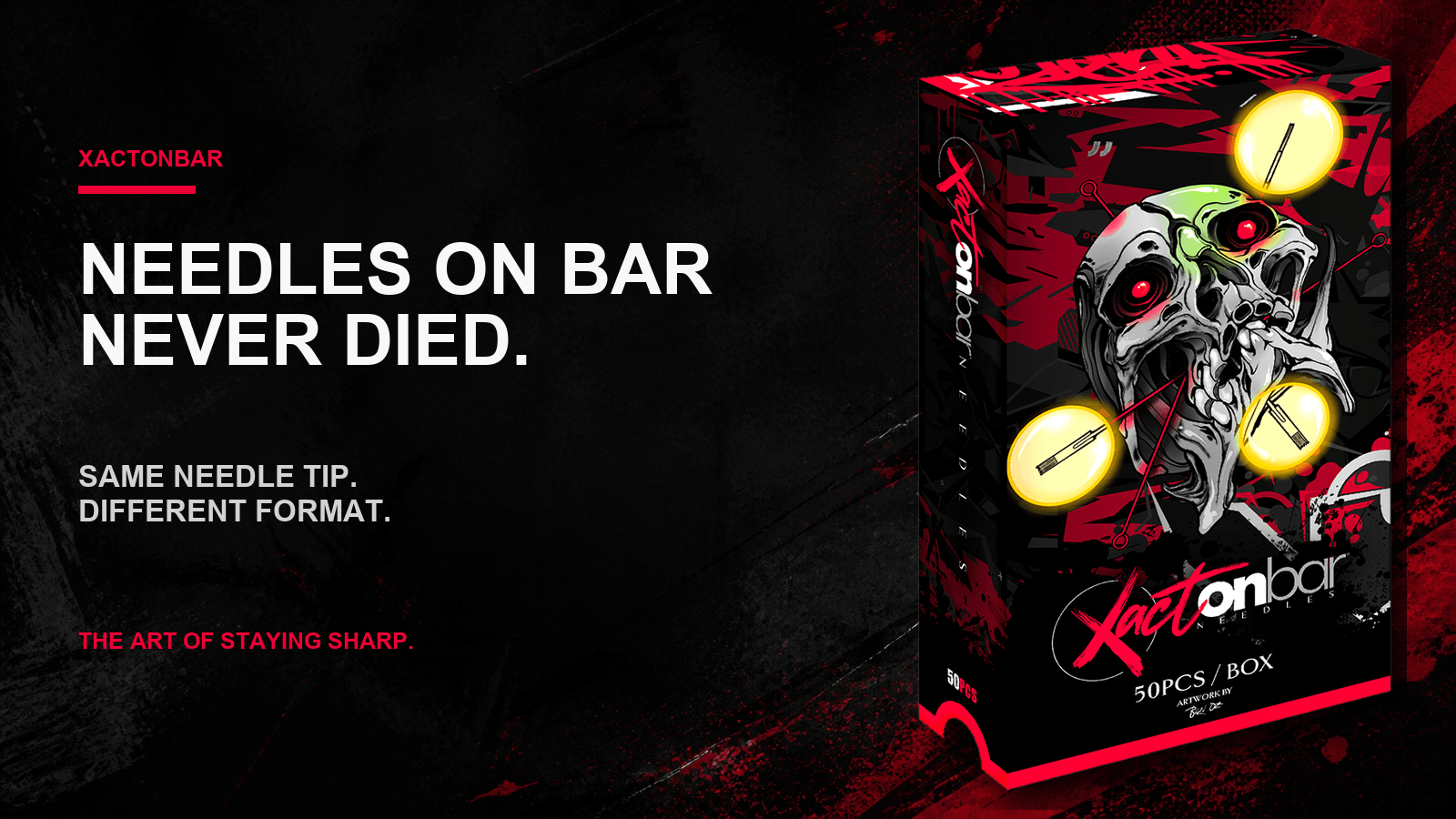
So we built XACTonbar.
It's simple: the working needle tip is the same needle tip we use in our XACTneedle cartridges.
That is not marketing shorthand for “similar.” We didn't design a lower-grade needle for the traditional crowd. We didn't loosen the standard because the format costs less to assemble. We took the needle artists already trust and put it on a bar.
Different format. Same standard. That's the whole idea.
The grouping still has to be right. The taper still has to be consistent. The finished needle still has to meet the expectations behind the XACT name. Putting it on a bar does not change any of that.
XACTonbar is not our attempt to drag traditional artists into our cartridge business. It is us meeting them where they already work.
We Didn't Design It Alone
XACTonbar was developed with input from someone who would actually put it to work.
Ben Oz—Ben Osrowitz—is the co-owner of Twisted Tuna Tattoo in Lake Worth, Florida. His work runs dark: neo-traditional, neo-Japanese and illustrative.
Ben helped shape XACTonbar from the working side of the machine. There is a difference between designing something that looks right on a specification sheet and developing something for an artist who is actually going to use it.
This was not a licensing deal where we finished a product and then went looking for a recognizable name to put on the box. Ben was involved with the needle first. When the tool was right, he created the artwork for the packaging.
That order matters to us.
The tool came first. The packaging came second.
You can see Ben's work at @benoztattoos on Instagram.
This Isn't a Retro Product
We understand the temptation to frame needles on bar as a throwback. That makes for an easy story. It is also wrong.
XACTonbar is not about recreating some imaginary golden age of tattooing. It is about serving artists who use this format now.
They don't need sepia-toned nostalgia. They need straight needles, consistent groupings, clean construction and packaging they can trust.
There is nothing retro about demanding a professional tool do its job.
We're not bringing needles on bar back. They never left.
One Thing That Isn't Optional
Whatever format you run, sterility isn't old school or new school. It's the baseline.
The CDC recommends sterilized or single-use tattoo equipment, and the FDA warns that nonsterile equipment carries real infection risk.
Packaging is not decoration. A sterile label is not a substitute for disciplined manufacturing, validated processes and a package that stays intact until the artist opens it.
We've been manufacturing needles in an FDA-registered facility for over 25 years. That is the standard XACTonbar was built under, same as everything else we make.
We wrote more about why that matters in Tattoo Needle Safety: The Unregulated Truth.
XACTonbar Is Coming
We're not announcing configurations or a launch date yet. We'll release those details when they're ready, not because a content calendar says we need another announcement.
But we can say this:
XACTonbar is coming.
- Same needle tip as our cartridges.
- Built with a working tattooer.
- Made for the artists who never left the bar.
We did not build it to replace cartridges. We built it because traditional artists deserve the same attention we give our flagship line.
XACTonbar. The art of staying sharp.
FAQs
Are tattoo needles on bar obsolete?
No. Cartridge systems are widely used, but professional artists continue using tattoo needles on bar with coil and compatible rotary machines. The choice comes down to the artist's equipment, workflow and preferred feel.
Are cartridges better than tattoo needles on bar?
Not automatically. Cartridges offer faster changes and an integrated setup. Tattoo needles on bar give artists more component-level control and work naturally with traditional machine setups. Neither format replaces skill.
What is XACTonbar?
No. They are strongly associated with coil machines, but compatible rotary machines can also run conventional needle bars. Artists should confirm compatibility with their specific machine, tube and grip.
Who is Ben Oz?
Ben Oz—Ben Osrowitz—is a South Florida tattoo artist and co-owner of Twisted Tuna Tattoo in Lake Worth. He helped develop XACTonbar and created the original artwork on its packaging.
When will XACTonbar be available?
XACTonbar is coming soon. Follow XACTbodyart and Ben Oz for the product reveal, available configurations and release information.