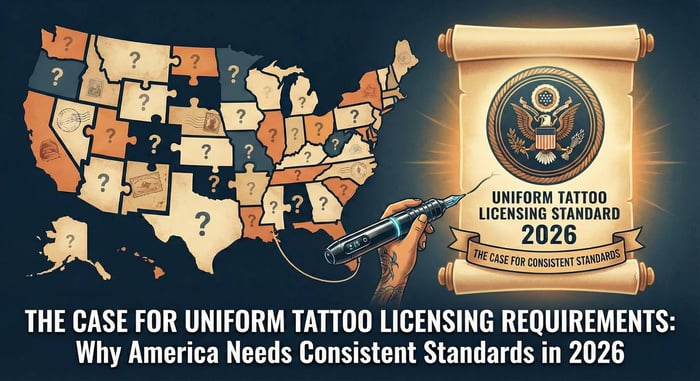
The Case for Uniform Tattoo Licensing Requirements: Why America Needs Consistent Standards in 2026

Table of Contents
- The Current State of Tattoo Licensing Requirements: Extreme Variation
- Complete State-by-State Requirements Reference
- Why Inconsistent Tattoo Licensing Requirements Harm the Industry
- Understanding the Practical Impact of Inconsistent Tattoo Licensing Requirements
- Why the Current System Undermines Both Safety and Professionalism
- Facility Standards: Where Tattoo Licensing Requirements Show More Convergence
- The Zoning Challenge That Affects Industry Recognition
- Recent Legislative Developments in Tattoo Licensing Requirements
- The Consumer Protection Challenge With Inconsistent Tattoo Licensing Requirements
- What Problems Uniform Standards Would Address (And What They Wouldn't)
- Addressing Arguments Against Standardizing Tattoo Licensing Requirements
- Building Industry Consensus on Tattoo Licensing Requirements
- Conclusion: Why Baseline Tattoo Licensing Requirements Matter for the Industry's Future
- FAQs
If you try to get a driver's license, the requirements are roughly similar whether you're in Maine or California. But tattoo licensing requirements? They're wildly inconsistent. An artist who spends 2,000 hours training in Connecticut can't practice in Florida without starting over. A Florida-licensed artist who passes a bloodborne pathogens exam wouldn't meet Oregon's education requirements. And in states like Arizona, you might not need any state-level license at all.
This isn't just bureaucratic inconvenience. It's a professionalism problem and an economic barrier that undermines the entire tattoo industry. When requirements vary this dramatically, the credential itself becomes meaningless.
This article examines why America needs uniform standards for tattoo licensing. We'll document the current fragmented system, demonstrate how inconsistent requirements harm both artists and the industry's professional credibility, and explain why standardization matters for the future of body art as a legitimate profession.
The Current State of Tattoo Licensing Requirements: Extreme Variation
How Inconsistent Are Tattoo Licensing Requirements?
Requirements currently range from non-existent to highly restrictive depending on where you live. Consider these documented examples:
Connecticut requires 2,000 hours of documented apprenticeship training. The state also offers an alternative pathway for artists with continuous practice before 2015. Connecticut's requirements treat tattooing as a procedure requiring extensive supervised training.
Florida requires no apprenticeship hours whatsoever. Pass a bloodborne pathogens exam with a 70% score, and you can legally tattoo clients immediately if you work in a licensed shop.
Oregon mandates graduation from a licensed 360-hour vocational school with 210 hours of theory (microbiology, immunopathology, color theory) and 150 hours of practical application including 50 documented procedures. You cannot apprentice your way into licensure in Oregon under any circumstances.
Illinois requires artists to register and complete bloodborne pathogens training but issues no individual artist license. Only establishments are permitted.
Arizona generally does not issue statewide requirements for individual artists. Regulation is primarily at the county or municipal level with significant variation. Some localities require registration or permits, others have minimal requirements.
This isn't variation around a common baseline. These are fundamentally incompatible regulatory philosophies applied to the same profession performing the same procedures on the same human bodies. When requirements differ this dramatically, the term "licensed tattoo artist" communicates nothing consistent to the public.
The Two Competing Models for Tattoo Licensing Requirements
States have developed licensing requirements based on two opposing philosophical frameworks:
The Health Department Model (Texas, Florida, Illinois, Iowa)
These states view tattooing primarily as an infection control issue. Regulatory authority sits with state health departments. The focus is on bloodborne pathogens, sterilization, and facility sanitation. Artistic training duration is largely irrelevant. Pass your BBP course, maintain a sanitary environment, and you're compliant. These requirements prioritize disease prevention over skill verification.
The Professional Board Model (Virginia, Oregon, New Mexico)
These states treat tattooing as a skilled trade requiring verified vocational competency. Regulatory authority sits with professional licensing boards (often the same boards governing cosmetology or barbering). These requirements mandate extensive apprenticeships or formal education, curriculum standards, and documented performance requirements.
Neither model is inherently superior, but the fact that neighboring states can't agree on whether tattooing is primarily a health concern or a vocational skill creates significant problems. When requirements reflect such different philosophical assumptions, the industry suffers.
Complete State-by-State Requirements Reference
The variation in licensing requirements across all 50 states is dramatic. We've compiled a comprehensive chart showing specific hour requirements, regulatory authorities, education mandates, and reciprocity rules for every state.
→ View Our Complete 50-State Tattoo Licensing Requirements Chart (2026)
The chart includes:
- Exact apprenticeship hour requirements for each state
- Which states require individual artist licenses vs. facility-only licensing
- BBP certification requirements and renewal schedules
- Contact information for each state's regulatory authority
- Notes on recent legislative changes
- Guest artist permit information and fees
Understanding your state's specific requirements is essential before beginning training or relocating your practice.
Why Inconsistent Tattoo Licensing Requirements Harm the Industry
The Professional Credibility Crisis
The extreme variation in requirements undermines the industry's professional credibility in fundamental ways.
When an Oregon artist with 360 hours of formal schooling works next to an Arizona artist with potentially minimal formal training, what does "licensed tattoo artist" actually mean to the public? Nothing consistent. The credential itself loses meaning when requirements vary from comprehensive to minimal or non-existent.
Compare this to medical licensure. A physician licensed in one state can practice in another through reciprocity agreements because there are consistent baseline standards (medical school, residency, board exams). The license means something uniform. Patients know what to expect.
But requirements are so inconsistent that the term "licensed tattoo artist" communicates almost no information about training, competency, or safety practices. A client researching artists has no way to understand what Connecticut's 2,000-hour requirement means versus Florida's exam-only approach versus Arizona's minimal statewide requirements.
This credibility gap affects the entire industry:
Insurance Coverage: Insurers can't develop standardized coverage for tattoo-related claims when requirements vary so dramatically. What constitutes "adequately trained" for liability purposes?
Consumer Protection: Clients can't make informed decisions about safety when they don't understand what different requirements actually verify.
Industry Advocacy: The industry can't speak with a unified voice in policy discussions when different segments operate under radically different requirements.
Professional Recognition: Tattooing remains stigmatized in some contexts partially because licensing requirements lack the consistency that characterizes recognized professions.
Economic Barriers from Fragmented Tattoo Licensing Requirements
The lack of uniform requirements creates significant economic barriers for artists trying to build careers.
Workforce Mobility Restrictions
An experienced artist who wants to relocate from Virginia to Oregon faces a difficult choice. Virginia's requirements include 1,000 hours of training (500 hours theory, 500 hours practical) with at least 100 documented performances. Oregon requires graduation from a 360-hour licensed vocational school. These are incompatible pathways—Virginia's apprenticeship-based training doesn't satisfy Oregon's school-based requirement.
The artist must spend $5,000+ on tattoo school to meet Oregon's mandatory education requirement, even though they have years of successful practice under Virginia's system. This isn't a minor inconvenience. When requirements don't transfer between states, artists can't pursue better economic opportunities without essentially restarting their careers.
Guest Artist Work Complications
Traveling artists who want to do guest spots in multiple states face bureaucratic complexity navigating different requirements. Florida allows 14-day guest registrations for $35 but only for artists from states with comparable requirements. Artists from jurisdictions with minimal statewide requirements may need to complete Florida's full licensure process.
California's county-level system limits reciprocity further. Many counties allow out-of-county registrations for only 5 consecutive days with a maximum of 15 days total per year. A West Coast tour requires multiple county permits because each jurisdiction maintains separate requirements.
Convention Participation Barriers
Major tattoo conventions draw artists from across the country. Some jurisdictions grant temporary exceptions for convention work, but many don't. Artists either skip conventions in states with restrictive requirements or risk working without proper credentials. This limits professional networking and economic opportunity.
Market Entry Barriers
The regulatory burden of navigating complex requirements favors established shops that can afford compliance specialists and discourages new market entrants. When artists must research and comply with dramatically different requirements in each locality, the startup costs for new studios increase significantly.
This reduces competition and innovation. Young artists who might open independent studios instead work as employees for established shops because navigating licensing requirements is too complicated and expensive.
The Apprenticeship Exploitation Problem
The lack of uniform requirements has created an environment where apprenticeship exploitation can occur more easily. When states have no clear standards for what training must include, problems arise.
Inconsistent Training Standards
In states with minimal oversight of requirements, aspiring artists sometimes pay substantial fees for "apprenticeships" that provide variable quality training. Because requirements don't specify curriculum standards in many states, what counts as "training" can vary significantly.
Connecticut's requirements include 2,000 hours but without detailed standardized curriculum guidelines. The quality and content of that training can vary depending on the supervising artist.
Limited Verification Mechanisms
Most states' requirements include limited mechanisms to verify that promised training hours actually involved comprehensive education. The supervision and documentation requirements vary significantly by jurisdiction.
Difficulty Comparison Shopping
Because requirements vary so dramatically and apprenticeship pathways lack standardization across states, aspiring artists struggle to evaluate training quality. The market can't effectively differentiate because requirements don't establish consistent expectations for what legitimate training includes.
Understanding the Practical Impact of Inconsistent Tattoo Licensing Requirements
What "Licensed" Actually Means in Different States
When a client sees "licensed tattoo artist" on a shop's website, what does that actually tell them? The answer depends entirely on which state's requirements govern that artist.
In Connecticut:
"Licensed" means the artist completed 2,000 documented hours of supervised training (or qualified under the pre-2015 practice history pathway). Connecticut's requirements ensure extensive practical experience.
In Florida:
"Licensed" means the artist passed a bloodborne pathogens exam with a 70% score. They might have extensive experience, or they might have minimal practical experience. Florida's requirements focus on disease prevention knowledge, not skill verification through apprenticeship hours.
In Arizona:
"Licensed" or "registered" might refer to county or municipal registration with varying requirements. Arizona generally lacks statewide requirements for individual artists, so credentials depend on locality.
This creates a credibility challenge. When requirements vary this dramatically, consumers can't use licensure as a consistent indicator of training or competency.
The Reciprocity Challenge for Traveling Artists
The fragmented nature of requirements creates complications for artists who work across state lines.
Example: East Coast Artist Mobility
An artist based in Virginia with 1,000 hours of training and 100 documented performances meets Virginia's requirements. If they want to relocate to Oregon, Virginia's apprenticeship-based training doesn't satisfy Oregon's school-based requirements. The artist must complete Oregon's mandatory 360-hour vocational program despite years of successful practice.
If the same artist wants to do temporary guest work in Florida, they can apply for a 14-day guest registration if Florida deems Virginia's requirements comparable. But if they want to work in New York City, they must obtain NYC's guest license and pass the Infection Control Exam regardless of their Virginia credentials.
This patchwork means an experienced, competent artist faces different barriers depending on where they want to work, not because their skills differ but because requirements are incompatible.
The School vs. Apprenticeship Divide in Tattoo Licensing Requirements
One of the most significant incompatibilities in requirements is the divide between states that accept traditional apprenticeships and those that mandate formal education.
Oregon's Model: Mandatory Vocational Education
Oregon's requirements mandate graduation from a licensed 360-hour vocational school. Traditional apprenticeship does not satisfy Oregon's requirements under any circumstances. The curriculum includes 210 hours of theory (microbiology, immunopathology, color theory) and 150 hours of practical application with 50 documented procedures.
Supporters argue this ensures standardized curriculum, professional instruction, and protection from potential apprenticeship exploitation.
Critics argue this model prioritizes formal education institutions over traditional mentorship culture and may not produce more competent artists despite meeting formal requirements.
Traditional Apprenticeship States
Most states' requirements allow or require traditional apprenticeship under a licensed mentor. Connecticut's 2,000 hours, Virginia's 1,000 hours, and South Carolina's 1,000 hours all assume learning occurs through supervised practice rather than classroom instruction.
Supporters argue real-world experience is more valuable than classroom theory and that mentorship preserves craft traditions.
Critics note the lack of standardized curriculum means variable quality and that verification mechanisms are often limited.
The incompatibility means an artist who meets Oregon's formal education requirements wouldn't automatically meet Connecticut's apprenticeship-based requirements, and vice versa.
Why the Current System Undermines Both Safety and Professionalism
The Safety Baseline Question
Every state that regulates tattooing claims the goal is protecting public health and safety. Yet the dramatic variation in requirements suggests states disagree fundamentally about what safety actually requires.
Does safety require 2,000 hours of supervised training (Connecticut) or just passing a bloodborne pathogens exam (Florida)? Does it require formal classroom education in microbiology (Oregon) or is practical apprenticeship sufficient (Virginia)? Do artists need anatomy and physiology coursework (Massachusetts, Rhode Island) or is that unnecessary (Texas, Florida)?
If the purpose of requirements is genuinely safety, then presumably there's evidence about what training duration and content actually correlates with safe practice. The current variation suggests most states are not basing their requirements primarily on safety evidence.
Uniform requirements developed from actual evidence about safety best practices would serve the public better than the current system where requirements appear to reflect political compromise or historical accident rather than data.
The Professionalism Argument for Uniform Tattoo Licensing Requirements
For tattooing to be recognized as a legitimate profession rather than an unregulated trade, it needs consistent professional standards.
Recognized professions have relatively uniform requirements:
- Physicians: Medical school, residency, board certification (slight state variation but substantial similarity)
- Attorneys: Law school, bar exam (state-specific but fundamentally similar process)
- Accountants: Accounting degree, CPA exam (national standard exam)
- Cosmetologists: State-approved training program, state exam (variation exists but within narrower range than tattoo requirements)
These professions have professional credibility partially because their requirements are consistent enough that credentials mean something predictable.
Requirements need similar consistency for the industry to achieve full professional recognition. When Connecticut's 2,000-hour requirement and Florida's exam-only requirement both produce "licensed tattoo artists," the credential lacks consistent meaning.
Standardized requirements would establish what minimal professional competency actually means, giving the industry a foundation for professional credibility.
Facility Standards: Where Tattoo Licensing Requirements Show More Convergence
While training requirements for artists vary substantially, requirements for facilities show more consistency across states. Most states with any regulation require:
Sink Requirements in Tattoo Licensing Requirements
Nearly all states' requirements mandate:
- Dedicated handwashing sinks with hot and cold running water
- Sinks located within procedure areas
- Separation between handwashing and equipment cleaning functions
Southern Nevada's requirements enforce one hand sink per four workstations located no more than 15 feet from any procedure table.
Washington's requirements demand two separate sinks: one exclusively for handwashing, another for equipment cleaning.
Iowa's requirements mandate plumbed-in handwashing sinks (portable sinks prohibited in permanent establishments).
Floor and Surface Standards in Tattoo Licensing Requirements
Nearly universal in states with requirements:
- Smooth, non-absorbent, non-porous flooring (concrete, tile, heavy-duty vinyl)
- Carpet prohibited in procedure areas
- Cleanable, non-porous surfaces for all work areas
- Separate areas for tattooing versus sterilization
Sterilization Equipment Requirements
Most states' requirements mandate:
- Autoclave or other approved sterilization equipment for reusable instruments
- Documented sterilization cycles with testing
- Biological indicator testing (spore tests) on regular schedules
- Single-use needles and ink cups
This convergence on facility standards demonstrates states can agree on evidence-based safety requirements. Similar convergence should be possible for training and competency standards in requirements.
The Zoning Challenge That Affects Industry Recognition
Even with strong licensing requirements, the industry faces another barrier: local zoning ordinances that classify tattoo studios unfavorably.
Many municipalities zone tattoo parlors alongside adult entertainment businesses. This relegates studios to industrial areas or prohibits them in commercial districts.
Atlanta: City of Ink faced closure when the city enforced a 2008 ordinance banning tattoo parlors in the Castleberry Hill historic district.
Fredericksburg, Virginia: Confined studios to limited areas, typically industrial parks.
Erie, Pennsylvania: Zoning Hearing Board granted variance to classify a studio as "professional service" based on appointment-only model, setting precedent for treating tattoo studios more like medical offices.
Uniform requirements could help with zoning battles by establishing tattooing as a regulated, professional service rather than an unregulated trade. When states have consistent, rigorous requirements, municipalities have less justification for restrictive zoning.
But zoning remains fundamentally a local decision. Standardized requirements would improve industry credibility, which might influence zoning decisions, but wouldn't directly override local zoning authority.
Recent Legislative Developments in Tattoo Licensing Requirements
Several states are currently considering reforms to their requirements:
Pennsylvania: Proposed Statewide Tattoo Licensing Requirements
Pennsylvania has historically operated with minimal statewide requirements. House Bill 1180, currently pending in the Professional Licensure Committee (referred April 9, 2025), would establish:
- Statewide licensure for all artists and establishments
- Bloodborne pathogens education requirements
- Annual Department of Health inspections
- Shift from complaint-based enforcement to proactive inspection
If enacted, Pennsylvania's reform would recognize that the absence of consistent statewide requirements creates safety and professional credibility concerns.
North Carolina: Proposed Mobile Tattoo Parlor Regulations
North Carolina House Bill 830, introduced in 2025, would legalize mobile tattoo parlors with specific requirements:
- Annual permits from local health departments ($5,000 initial fee proposed)
- Hot and cold running water systems
- Waste disposal systems identical to brick-and-mortar shops
- Prohibition on tattooing while vehicle is in motion
- Class 1 misdemeanor for willful violations
If enacted, this would represent evolution in requirements to accommodate new business models while maintaining safety standards.
Tennessee: Experience-Based Reciprocity in Tattoo Licensing Requirements
Tennessee's Senate Bill 497 (enacted) allows tattoo artists licensed in another state for 10 years or more to bypass Tennessee's typical 3-year local experience requirement. This legislative acknowledgment that long-term experience should supersede specific local requirements represents progress toward recognizing equivalent competency across different training systems.
Illinois: Vocational Training in Corrections
Illinois' SB 2986 established a pilot program in the Department of Corrections to remove gang tattoos from inmates and train them as body artists. This treats tattooing as a viable vocational rehabilitation path while acknowledging that formerly incarcerated individuals can meet professional standards and obtain proper licensure under Illinois' requirements.
The Consumer Protection Challenge With Inconsistent Tattoo Licensing Requirements
From a consumer protection perspective, the variation in requirements creates information asymmetry.
Clients Can't Evaluate Artist Qualifications
A client in Virginia researching artists sees "licensed" on every reputable artist's website. But without understanding Virginia's specific requirements (1,000 hours, 100 documented performances, board approval), the client can't assess whether this represents rigorous verification or minimal standards.
If the client moves to Florida or travels for a tattoo, they have no way to compare Virginia's requirements with Florida's. They can't know that Florida's requirements are dramatically different in structure (exam-based versus apprenticeship-based).
This information asymmetry prevents clients from making fully informed decisions about safety and quality.
"Licensed" Becomes Generic Marketing Language
When requirements vary so dramatically, "licensed tattoo artist" becomes marketing language rather than meaningful credential verification.
Artists in regulated states all claim to be "licensed" regardless of whether that means 2,000 hours of supervised training or passing a single exam. Clients have limited ways to distinguish between these different levels of preparation.
Uniform requirements would make licensure more meaningful. Clients could trust that "licensed" means meeting specific, consistent standards rather than whatever that particular state happens to require.
Interstate Clients Face Information Gaps
Approximately 30% of Americans now have at least one tattoo. Many get tattooed while traveling, on vacation, or living temporarily in different states.
A client who got safely tattooed in Connecticut (where requirements ensure extensive training) might assume that Florida artists with "licensed" credentials have similar training backgrounds. They don't. Florida's requirements are structurally different.
This creates information gaps for interstate clients because they can't know what "licensed" means in each jurisdiction.
What Problems Uniform Standards Would Address (And What They Wouldn't)
Being specific about what uniform requirements would solve and what they wouldn't is important.
Problems Uniform Tattoo Licensing Requirements Would Address:
Professional Credibility: Establishes consistent meaning for "licensed tattoo artist" that builds public understanding and trust
Workforce Mobility: Allows artists to relocate between states without redundant training or relicensing if they meet the baseline standard
Guest Artist Work: Simplifies temporary work in other states through clearer reciprocity
Consumer Information: Gives clients consistent baseline for understanding what licensure verifies
Apprenticeship Protection: Provides clearer standards for what training must include
Industry Voice: Allows industry to speak more effectively about professional standards
Safety Baseline: Establishes minimum competency requirements based on evidence rather than varying political compromises
Problems Uniform Tattoo Licensing Requirements Would NOT Solve:
Artistic Quality: Licensure verifies safety competency, not artistic skill or style quality
Business Success: Meeting licensing requirements doesn't guarantee economic viability
Zoning Restrictions: Local zoning remains under municipal control regardless of licensing standards
Shop Quality: Facility licensing is separate from individual artist licensing
Client Satisfaction: Competent artists can still produce work clients don't like
All Industry Competition Issues: Standardization addresses some barriers but doesn't eliminate all competitive challenges
Understanding these limitations is important. Uniform requirements would address professional credibility and mobility issues but wouldn't solve all industry challenges.
Addressing Arguments Against Standardizing Tattoo Licensing Requirements
"This Will Increase Costs"
The Argument: Uniform requirements will increase compliance costs, forcing small shops to close and reducing access to services.
The Reality: The current system already imposes significant costs through complexity. Multi-state operations pay licensing fees in multiple states, maintain separate compliance systems, and deal with varying requirements. Artists who relocate must often complete redundant training to meet different states' requirements.
Standardized requirements could reduce compliance costs by creating credentials valid across states, eliminating some duplicative fees, standardizing certain facility requirements, simplifying some record-keeping, and enabling artists to move between shops more easily.
The question isn't whether standards cost money (they do), but whether uniform standards cost more than the current fragmented system. The current complexity imposes real costs that standardization could reduce.
"States Should Control Professional Licensing"
The Argument: Professional licensing has traditionally been a state function. Standardizing requirements would represent overreach.
The Reality: States regulate professions when practice poses primarily localized risks. But tattooing involves interstate commerce (traveling artists, conventions, multi-state businesses) and procedures that are identical regardless of location.
When artists frequently work across state lines and the procedures themselves don't change based on geography, the traditional state-by-state licensing model creates barriers without corresponding benefit.
Uniform baseline requirements wouldn't eliminate state authority. States could still add supplementary requirements beyond baseline standards, regulate facilities, and enforce safety protocols. Standardization would just establish a baseline, not a ceiling.
"Apprenticeship Culture Will Be Destroyed"
The Argument: Standardization will force artists into formal schools, destroying traditional apprenticeship culture.
The Reality: This concern conflates uniformity with prescriptivism. Uniform requirements could explicitly permit both apprenticeship and formal education as pathways to licensure. The question is whether there should be consistent standards for what training must include, not whether apprenticeship should exist.
Current requirements that allow apprenticeship but provide minimal curriculum standards or verification mechanisms can actually enable exploitation. Standardized requirements that specify what training must cover while allowing flexibility in delivery could protect apprenticeship while eliminating some abuses.
"This Creates More Bureaucracy"
The Argument: Adding standardization creates more bureaucratic complexity, not less.
The Reality: The current system forces artists to navigate 50 separate regulatory systems with different rules, forms, fees, and enforcement mechanisms. That complexity exceeds what a more unified baseline system would create.
Compare to driver's licenses: every state issues them, but they follow broadly similar standards and offer reciprocity. This system is less complex than requiring separate licenses for every state you drive in.
Uniform baseline requirements could operate similarly, potentially reducing rather than increasing bureaucratic burden for artists who work across state lines.
Building Industry Consensus on Tattoo Licensing Requirements
The tattoo industry needs conversations about what uniform baseline requirements should include. This conversation should involve:
Essential Stakeholders
Professional Artist Associations: Organizations representing working tattoo artists need central roles in defining competency standards.
Public Health Officials: Health department officials bring evidence about actual safety risks and effective prevention measures.
State Regulators: Officials currently administering requirements in various states have practical experience.
Educational Institutions: Both vocational schools and shop owners running apprenticeships understand training delivery.
Consumer Representatives: Individuals representing tattooed clients can speak to what consumers need.
Insurance Industry: Insurers understand liability risks and what training correlates with safety outcomes.
Questions Requiring Evidence-Based Answers
Training Duration: What minimum training duration correlates with competent, safe practice? Is there evidence distinguishing outcomes at different hour thresholds?
Curriculum Content: What specific knowledge and skills must training cover? What's essential versus optional?
Education vs. Apprenticeship: Is there evidence that formal education produces different outcomes than traditional apprenticeship? Should standards accommodate both paths?
Examination Requirements: Should baseline requirements include written exams, practical exams, or both? What should they assess?
Continuing Education: Should artists complete ongoing education to maintain licensure?
Reciprocity Mechanisms: How should artists currently licensed under various state requirements transition to any new baseline system?
Building Consensus Process
The tattoo industry has historically been fragmented. Building consensus on baseline requirements requires:
National Dialogue: Conferences, forums, and working groups bringing together stakeholders
Research and Data: Evidence about safety outcomes, training effectiveness, and consumer needs
Pilot Programs: States testing approaches and sharing results
Professional Standards Development: Industry associations developing model curriculum and competency standards
Public Input: Soliciting feedback from both artists and consumers
This isn't something that can be imposed from outside. The industry itself needs to lead the development of appropriate baseline requirements.
Conclusion: Why Baseline Tattoo Licensing Requirements Matter for the Industry's Future
The current patchwork of requirements creates significant challenges. It undermines professional credibility because "licensed tattoo artist" means something different in every jurisdiction. It restricts workforce mobility because credentials don't transfer between states. It creates information asymmetry because consumers can't understand what licensure actually verifies.
Approximately 30% of Americans now have at least one tattoo. This is mainstream body modification that deserves professional recognition and reasonable consistency in standards. The industry has evolved beyond underground shop culture into a recognized profession, but fragmented requirements prevent full professional legitimacy.
Artists want their credentials to mean something consistent. Clients want to understand what "licensed" actually verifies about training and competency. Health departments want reasonable baseline standards they can implement and enforce.
Baseline uniform requirements would address these concerns while preserving space for state variation beyond minimums, accommodating both apprenticeship and formal education pathways, and protecting the industry's cultural heritage.
The question isn't whether some level of consistency in standards is beneficial. The current variation makes that case clearly. The question is what those baseline requirements should include and how the industry builds consensus around them.
That conversation needs to happen. The industry's credibility, artists' economic mobility, and clients' ability to make informed decisions all depend on developing more consistent requirements that actually mean something predictable.
This analysis reflects publicly available regulatory information current as of February 2026. Requirements change frequently. Always verify current requirements with your specific state health department or licensing board before making training or business decisions. This is not legal advice. Consult an attorney in your jurisdiction for specific compliance guidance.
FAQs
Do all states currently require tattoo licensing?
No. Requirements vary dramatically by state. Some states like Delaware, Illinois, and Michigan don't require individual artist licenses, only facility licenses. Arizona generally lacks statewide individual artist licensing requirements, with regulation primarily at county/municipal levels.
What are typical tattoo licensing requirements across different states?
There is no single "typical" standard—that's the problem. Requirements range from comprehensive multi-year apprenticeship programs (Connecticut's 2,000 hours) to exam-based systems (Florida's bloodborne pathogens exam) to minimal statewide requirements (Arizona).
Can tattoo artists work across state lines with their current license?
Very limited reciprocity exists. Some states offer guest artist permits or registrations for short-term work, but requirements vary significantly. Most artists cannot simply practice in another state based on their home state license because requirements are often incompatible.
Why do tattoo licensing requirements vary so much between states?
States disagree fundamentally about whether tattooing is primarily a health issue (requiring disease prevention training) or a vocational skill (requiring extensive practical training). This philosophical divide produces dramatically different requirements.
What would standardization mean for state control?
Baseline uniform requirements could establish minimum standards while allowing states to add supplementary requirements beyond those minimums. This is how many professional licensing systems work—consistent baselines with state flexibility to exceed them.
How can I find my state's specific requirements?
Check our comprehensive 50-state chart for your state's regulatory authority, exact hour requirements, fees, and contact information.
What's the difference between BBP certification and apprenticeship hours?
BBP (Bloodborne Pathogens) certification is safety training focused on preventing disease transmission. Apprenticeship hours represent supervised practical training in tattooing techniques. Some states require only BBP certification, others require extensive apprenticeship, and some require both.
If I'm licensed in one state, which other states will accept my license?
It depends on your home state's requirements and where you want to work. Florida accepts guest artists from states with "comparable" requirements. Tennessee accepts artists with 10+ years of experience from other states. New York City requires everyone to pass their Infection Control Exam