
Professional Piercing Needles vs Guns: The Shocking Truth

Table of Contents
- The Hidden Dangers of Piercing Guns: Why Professional Piercing Needles Are the Only Safe Choice
- Quick Facts: Piercing Guns vs. Needles
- The Trauma Problem: Blunt Force vs Precision Needles
- Cartilage Piercings Are Where the Real Damage Happens
- The Jewelry Makes It Worse
- Minimal Training, Maximum Liability
- The Numbers Don't Lie
- Choose the Option Meant for the Human Body
- Why Professionals Choose XACTpierce™
- FAQs
The Hidden Dangers of Piercing Guns: Why Professional Piercing Needles Are the Only Safe Choice
Most people walk into a mall kiosk believing a piercing gun is a harmless shortcut. It's fast, cheap, and familiar. But behind that convenience is a long, documented history of infections, cartilage destruction, and surgical complications that professional piercers have been warning about for decades. When you compare piercing guns to professional piercing needles, the difference in safety, sterility, and healing outcomes is massive — and the medical evidence backs it up.
The Association of Professional Piercers prohibits members from using piercing guns. Several states ban guns on cartilage. Countries like Mexico have outlawed them entirely. Medical literature is loaded with cases showing exactly why.
Quick Facts: Piercing Guns vs. Needles
| Factor | Piercing Gun | Professional Needle |
|---|---|---|
| Sterilization | Cannot be autoclaved (plastic melts) | Single-use, pre-sterilized |
| Mechanism | Blunt force trauma | Clean tissue removal |
| Tissue Damage | Crushes and tears | Precise cutting |
| Healing Time (Lobe) | 6-8 weeks | 4-6 weeks |
| Healing Time (Cartilage) | 6-12 months (NOT recommended) | 3-6 months |
| Infection Rate | Significantly higher | Lower with proper technique |
| Jewelry Options | Limited to pre-loaded studs | Customizable to anatomy |
| Operator Training | Often just hours | Months to years |
| Professional Standards | Banned by APP members | Industry standard |
The foundational problem is simple: piercing guns can't be autoclaved. They're made of plastic that melts under true sterilization conditions. Wiping them with an antiseptic pad doesn't remove microscopic blood and tissue.
Public Health Ontario's 2024 report documented that 35% of people who received piercings reported complications. In 2004, the Journal of the American Medical Association reported an outbreak where 25 people developed Pseudomonas aeruginosa infections from a jewelry kiosk using the same spring-loaded gun device, with some requiring hospitalization.
Professional piercing needles avoid this entirely. They're sterile, single-use, individually packaged, and disposed of immediately. No shared equipment. No lingering blood. No cross-contamination risk.
The Trauma Problem: Blunt Force vs Precision Needles
A piercing gun doesn't cut. It punches. It uses spring-loaded force to drive a blunt stud through tissue. The result is crush injury — torn tissue, swelling, and trapped debris.
Medical journals have documented that piercing guns can cause cartilage to crack in a stellate pattern, creating bleeding between the cartilage and perichondrium. A 2014 study in Plastic and Reconstructive Surgery described a teenager whose upper ear required surgical reconstruction after a gun piercing led to cartilage loss and permanent deformity.
A sterile professional piercing needle creates a clean, controlled opening by removing a tiny sliver of tissue. Less trauma means faster healing, fewer infections, and less scarring. It's the difference between a scalpel and a nail gun.
Cartilage Piercings Are Where the Real Damage Happens
Cartilage has poor blood supply, so once it's damaged, it struggles to heal. When a gun forces a stud through the upper ear or tragus, the cartilage can splinter. Medical literature has documented:
• Auricular chondritis requiring IV antibiotics
• Hypertrophic scarring and keloid formation
• Structural collapse of the helical rim
• Severe infections requiring surgical drainage
• Permanent ear deformities requiring reconstruction
A 2001 British Medical Journal article documented multiple cases of "cauliflower ear" developing after gun piercings, with patients experiencing loss of supporting cartilage in the upper pinna. These outcomes aren't rare — they're predictable consequences of using the wrong tool on the wrong tissue.
The Jewelry Makes It Worse
Gun studs are one-size-fits-nobody. They're too short to allow for normal swelling. Emergency medicine journals document numerous cases of completely embedded studs that had to be surgically removed.
The butterfly backs trap moisture, bacteria, and dead skin — exactly what a fresh wound doesn't need.
Professional piercers pair professional piercing needles with implant-grade titanium or 14k gold jewelry, using flatback or threadless designs that allow for proper swelling and cleaning. This isn’t luxury — it’s anatomy-driven safety.
Minimal Training, Maximum Liability
Most mall employees are trained by watching a video or practicing on foam. They're retail workers performing a medical-adjacent procedure on minors.
Professional piercers train for years. They learn anatomy, sterilization, bloodborne pathogen control, and complication management. They know when not to pierce, which jewelry fits, and how to avoid damaging nerves or cartilage.
You're not just choosing a tool — you're choosing an operator who understands the body they’re working on.
The Numbers Don't Lie
Research shows approximately one-third of piercings experience complications. That rate is significantly higher with guns. Many of these complications aren't reported because the clients are minors, or because people don’t realize the infection came from the method, not their aftercare.
A 2015 systematic review found that treatment delays of more than 5 days significantly increased hospitalization risk, and that Pseudomonas infections (which accounted for 87% of cartilage piercing infections in one study) were more likely to require hospitalization than Staphylococcus infections.
ER physicians see the real picture: abscesses, embedded studs, allergic reactions, cartilage collapses, and infected wounds from gun piercings.
Needle piercings simply do not produce this level of trauma or complication.
Choose the Option Meant for the Human Body
A piercing is a wound. It deserves sterile, single-use equipment and a trained professional. Piercing guns introduce unnecessary trauma and infection risk that professional piercing needles eliminate.
If you care about healing, accuracy, and safety, choose needles.
Why Professionals Choose XACTpierce™
XACTpierce™ Flagship Straight Piercing Needles
$22.00
Flagship. Sharpest. Unmatched. When precision matters, there is no substitute. XACTpierce™ Straight Piercing Needles are the flagship choice for professional piercing artists worldwide, delivering the… read more
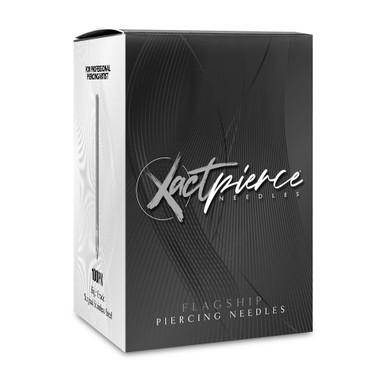
At XACTbodyart, we've spent more than 25 years perfecting medical-grade sharp manufacturing. Our XACTpierce™ Flagship Straight Piercing Needles represent the evolution of that expertise — bringing hospital-grade precision to professional piercing.
What sets XACTpierce™ apart:
• Japanese surgical stainless steel
• Tri-bevel precision sharpening
• Medical-grade US silicone coating
• Individual gamma sterilization
• Rigorous medical-style quality control
Professional piercers report that XACTpierce™ needles offer effortless entry with minimal tissue disruption. The polished surface and silicone coating work together to create a controlled, seamless insertion process that enhances both client comfort and piercing accuracy.
Premium quality shouldn’t require premium pricing. XACTpierce™ delivers medical-grade performance at a price point that respects your business.
When you choose XACTpierce™, you’re choosing 25 years of medical sharp expertise applied directly to body piercing. For many piercers, once they pierce with XACTpierce™, they don’t go back.
FAQs
What infections have been documented from piercing guns?
Medical literature includes cases of Pseudomonas aeruginosa perichondritis, Staphylococcus aureus infections, and severe cartilage infections requiring hospitalization and IV antibiotics, traced to contaminated piercing guns.
Can cartilage actually break from a piercing gun?
Yes. Published medical reports describe cartilage cracking in stellate patterns and permanent deformities caused by the blunt force of spring-loaded studs.
Why can't piercing guns be sterilized?
They're made of plastic that melts in an autoclave. Surface wipes don't kill bloodborne pathogens trapped inside the mechanism.
Why are professional piercing needles safer?
They are single-use, pre-sterilized, hollow, and designed to remove tissue cleanly rather than crush it. This reduces trauma and dramatically lowers infection risk.
Why do so many embedded earrings come from piercing guns?
Gun studs are too short to allow for swelling, so the tissue grows over them. Many require surgical removal.
Is a needle piercing more painful than a gun piercing?
Most clients say the opposite. A sharp hollow needle cuts cleanly and quickly, while a gun forces a dull stud through tissue.
What makes XACTpierce™ needles different from other piercing needles?
XACTpierce™ needles combine Japanese surgical steel, tri-bevel precision sharpening, medical-grade silicone coating, and 25 years of medical sharp manufacturing expertise—the same standards used for prescription-grade medical devices.