AI for Tattoo Artists: How to Make It Work For You (Not Replace You)

Table of Contents
- What AI for Tattoo Artists Actually Means
- What AI Actually Can't Do (So Stop Worrying)
- 1. Reference Generation (Stop Scrolling Pinterest for 3 Hours)
- 2. Turn Your Instagram Into a Money Printer
- 3. Stop Answering the Same Questions 500 Times
- 4. Flash Design Variations in 5 Minutes Instead of 5 Hours
- 5. Custom Aftercare Instructions That Actually Help
- 6. Write All Your Admin Bullshit Once
- 7. Figure Out If You're Leaving Money on the Table
- 8. Content Ideas When You're Out of Ideas
- The Three Prompts That Will Actually Make You Money
- Why AI for Tattoo Artists Is Not Optional Anymore
- The Real Point
- FAQs
AI for tattoo artists is the most misunderstood topic in the industry right now. Every time someone posts about it, half the comments are artists freaking out about robots taking their jobs. So let's kill that idea right now.
AI isn't replacing you. Here's why: it can't feel skin fighting back at the 45-minute mark. It can't talk a nervous client through their first session. It doesn't know why that placement is wrong for their body type. And it sure as hell can't fix a coverup of someone's ex's name spelled wrong in a font that was already ugly in 2003.
Your job is safe. But if you're not using AI for tattoo artists to handle administrative work, you're wasting hours every week on tasks that could be automated in seconds.
What AI for Tattoo Artists Actually Means
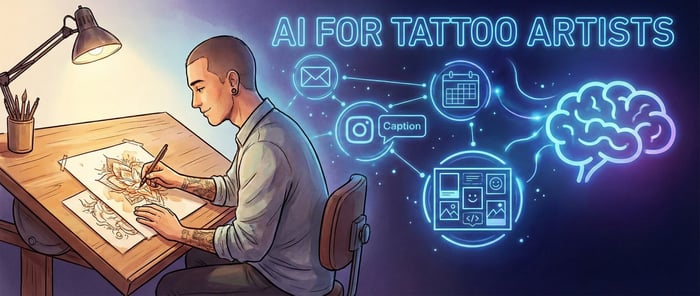
When people say AI for tattoo artists, they're not talking about robots holding machines. They're talking about tools that handle the parts of running a tattoo business that have nothing to do with actual tattooing. Reference gathering. Email responses. Social media captions. Scheduling questions. All the stuff that keeps you out of your chair.
The artists making money with AI for tattoo artists aren't using it to design tattoos. They're using it to get back to tattooing faster.
What AI Actually Can't Do (So Stop Worrying)
Tattooing is reading skin in real time. Every person's skin acts different. Stretches different. Bleeds different. You're adjusting needle depth and hand speed based on what you're feeling through the machine. No algorithm is replicating that.
The human element is half the job. Clients are buying YOU. The experience of being tattooed by you. Your vibe, your eye, your ability to know when they need a break or when to tell them to stop being dramatic about a tiny ankle piece.
AI has zero taste. It can mashup existing work but it has no point of view. It doesn't understand why that geometric piece needs more breathing room or why mixing too many styles looks like garbage. That's artistry. That requires judgment you built over years of actually doing the work.
But here's what AI for tattoo artists is actually good at.
1. Reference Generation (Stop Scrolling Pinterest for 3 Hours)
What to use: Midjourday or Leonardo.ai
This is where AI for tattoo artists saves you the most time upfront. Client wants a neo-traditional snake wrapped around peonies but every reference you find has roses or that played-out geometric style?
Open Midjourney on Discord. Type: "neo traditional snake coiled around pink peonies, vintage tattoo flash style, high contrast, bold lines, american traditional influence"
Thirty seconds later you've got 20 variations. Pick the best elements from each. Now you're drawing instead of scrolling.
Copy this exact prompt and customize it:
Create a tattoo reference image: [STYLE] [MAIN SUBJECT] with [SECONDARY ELEMENTS]. Technical specs: [bold lines/fine line/dotwork/etc], [black and grey/color], [composition notes like "wrapped around arm" or "circular composition"]. Artistic influence: [specific artists or eras if relevant]. Mood: [dramatic/delicate/aggressive/feminine/etc]. This is for reference only, I will be drawing the actual tattoo design.
Example: "Create a tattoo reference image: Japanese style koi fish with lotus flowers and water. Technical specs: bold lines, full color, vertical composition for forearm placement. Artistic influence: traditional irezumi, Horiyoshi III style. Mood: powerful but balanced. This is for reference only, I will be drawing the actual tattoo design."
The real move: Show clients what won't work. They want micro-realism of their dog in a one-inch circle on their wrist? Generate it and show them why it'll be a blob in six months. Sometimes people need to see the bad idea before they'll trust you.
2. Turn Your Instagram Into a Money Printer
What to use: ChatGPT (free version works fine)
This is where AI for tattoo artists really shines. You know what your work looks like. You don't know how to write captions that make people want to book you.
Take your best healed photo. Go to ChatGPT and use this prompt:
THE CAPTION PROMPT THAT ACTUALLY WORKS:
You're writing Instagram captions for a tattoo artist. Here's what you need to know:

My style: [black and grey realism/traditional/neo-traditional/fine line/etc]
This specific tattoo: [subject matter, size, placement]
What made it challenging: [coverup/tricky placement/client's skin type/technical aspect]
What I'm proud of: [specific technical achievement]
My personality: [how you'd describe yourself - sarcastic/educational/no-BS/funny/etc]

Write 3 caption options:
- First one: Educational (explain a technique or why something works)
- Second one: Behind the scenes (the story or process)
- Third one: Direct and confident (just state what it is and why it's good)

Keep each under 150 characters before hashtags. Sound like a real person, not a corporate account. No emoji unless it actually adds something. End with a call to action that's not desperate.
It spits out three options in 5 seconds. Pick one, tweak it to sound like you, post it. You just saved 20 minutes of staring at your phone trying to think of something clever.
Next level: Ask it to analyze your last 20 captions and tell you which ones probably performed best and why. Feed that info back in. Now it's writing captions in your voice that actually convert.
Most artists using AI for tattoo artists say Instagram automation is the biggest immediate win. Your portfolio stays active even when you're booked solid.
3. Stop Answering the Same Questions 500 Times
What to use: ManyChat or Chatbot on your Instagram/Facebook
Every week you get the same messages:
- "How much for a sleeve?"
- "Do you do hands?"
- "Can I bring my friend?"
- "What's your deposit?"
This is basic AI for tattoo artists implementation, but it saves hours. Set up a basic chatbot that handles these before they even get to you. When someone DMs "how much," the bot sends them to your consultation form or explains your pricing structure.
You're not avoiding clients. You're filtering out the people who weren't serious anyway and saving the real conversations for people ready to book.
The specific setup: In ManyChat (free for basic), create automatic responses for keywords like "price," "cost," "book," "available," "deposit." Each one sends them exactly what you'd say anyway, plus a link to book. The serious clients get to you faster. The tire kickers get filtered.
4. Flash Design Variations in 5 Minutes Instead of 5 Hours
What to use: Midjourney + your actual drawing skills
Draw one strong traditional dagger. Clean, bold, exactly how you want it.
Upload it to Midjourney. Type: "variations of this traditional dagger tattoo flash, different backgrounds, maintain line weight and style, american traditional"
Now you've got that dagger with roses, with a snake, with geometric patterns, with script banners. Print 20 flash variations from one drawing.
You're still the artist. You're just not redrawing the same dagger 20 times. This is AI for tattoo artists working as a multiplier, not a replacement.
Reality check: You still need to draw the original. AI is not drawing flash for you. It's multiplying YOUR work so you can offer more variety without burning out.
5. Custom Aftercare Instructions That Actually Help
What to use: ChatGPT
Stop handing everyone the same generic aftercare sheet that doesn't account for whether they got a finger tattoo or a back piece, color or black and grey, summer or winter.
Go to ChatGPT: "Create detailed aftercare instructions for a [size] [color/black and grey] tattoo on [body part] done in [month]. Client has [skin type if relevant]. Include day-by-day guidance for the first week."
Boom. Customized instructions in 30 seconds. Add your shop logo, save it as a PDF, text it to them after the session.
Clients actually follow directions when the directions are specific to their situation. Smart use of AI for tattoo artists means better healing results and fewer panicked texts at 2am.
6. Write All Your Admin Bullshit Once
What to use: ChatGPT or Claude
AI for tattoo artists isn't about sounding fake. It's about not rewriting the same email 200 times.
You've written basically the same email 1,000 times:
- Consultation requests
- Explaining your deposit policy
- Turning down hand/face tattoos on first-timers
- Explaining why you can't work from their Pinterest board
- Following up on no-shows
Write each one perfectly one time. Save them. When you need them, copy, personalize one sentence, send.
THE EMAIL TEMPLATE GENERATOR (Copy This):
I'm a tattoo artist and I need email templates that sound professional but not corporate. My personality is [direct/friendly/educational/no-nonsense/etc]. My shop is [private studio/street shop/appointment only/walk-in friendly/etc].

Create templates for these 5 scenarios:

1. CONSULTATION REQUEST RESPONSE
Include: thanking them for reaching out, explaining my consultation process [in-person/virtual/photo submission], what info I need from them [placement, size, budget, reference images], typical timeline from consultation to appointment, and deposit policy.

2. DEPOSIT POLICY EXPLANATION
Include: deposit amount [$X or X% of estimated total], what it covers, that it's non-refundable but applied to final cost, acceptable payment methods, what happens if they need to reschedule [your actual policy].

3. DECLINING HANDS/FACE/NECK ON FIRST TIMER
Include: why I have this policy [job stoppers, need to understand commitment, etc], what I'd be willing to do instead, how many tattoos/years I require before doing these areas.

4. EXPLAINING MY DESIGN PROCESS
Include: that I don't work directly from Pinterest boards, I use references to create custom designs, why this gives them better work, how the collaboration works, when they'll see the design [day of/week before/etc - your actual process].

5. NO-SHOW FOLLOW UP
Include: noting they missed their appointment, asking if everything is okay, explaining deposit policy [lost or rescheduling rules], leaving door open if they want to rebook but making it clear this isn't acceptable.

Make each template 4-6 sentences max. Include a clear subject line for each. Sound like a human who respects their time and mine.
Edit them to sound like you. Save them in your phone. Never write them again.
7. Figure Out If You're Leaving Money on the Table
What to use: ChatGPT for analysis
Most artists are undercharging and don't realize it. Using AI for tattoo artists to analyze your business numbers is free money sitting on the table.
Tell ChatGPT: "I'm a tattoo artist. My hourly rate is $[X]. My average session is [Y] hours. My monthly overhead is $[Z] for rent, supplies, insurance. I want to make $[desired annual income]. Show me if my math works and what I should be charging."
It'll tell you if you're screwing yourself. Sometimes you need to see the numbers laid out to realize your $150/hour rate sounds good but you're only booked 15 hours a week and that doesn't cover your costs.
8. Content Ideas When You're Out of Ideas
What to use: ChatGPT
Your Instagram is dying because you're posting the same "fresh ink" caption for the tenth time this week.
Ask ChatGPT: "Give me 30 content ideas for a tattoo artist who does [your style]. Mix educational content, behind the scenes, client stories, and hot takes on the industry. Make them specific."
It spits out stuff like:
- "Three things that will make your tattoo age like garbage"
- "Why I turn down hand tattoos on first-timers (and you should too)"
- "The real reason your artist charges a deposit"
- "What 'fine line ages poorly' actually means"
Now you've got a month of content. Record yourself talking about each one. Post it. You just became the artist who actually educates instead of just posting finished work.
This is AI for tattoo artists as a content engine. Feed it your knowledge, it gives you the framework, you add your personality.
The Three Prompts That Will Actually Make You Money
If you're new to AI for tattoo artists, start here. These three prompts will show you immediate results.
If you do nothing else from this article, copy these three prompts into your phone right now:
PROMPT 1: The Reference Generator (for Midjourney/Leonardo.ai) This saves you hours of scrolling and gives clients visual proof of what will or won't work.
PROMPT 2: The Caption Writer (for ChatGPT)
This turns your Instagram from a portfolio into a booking machine by teaching you how to talk about your work in ways that convert.
PROMPT 3: The Email Template Builder (for ChatGPT/Claude) This gets you out of your inbox and back behind the machine by handling 90% of your admin work in one session.
Screenshot these. Use them today. Customize them for your style and your business.
Why AI for Tattoo Artists Is Not Optional Anymore
Here's the reality nobody wants to say out loud: the tattoo industry is getting more competitive. Instagram changed the game. Now clients can see work from artists worldwide before they book locally. The barrier to entry is lower than it's ever been.
The shops and artists who survive are the ones running actual businesses, not just showing up and hoping people book. AI for tattoo artists is part of running a real business in 2024 and beyond.
Every hour you spend doing something AI could handle is an hour you're not tattooing or not sleeping or not living your life. It's an hour you're not getting better at your craft. It's an hour your competition is using to pull ahead.
The Real Point
AI isn't here to replace you. It's here to handle the boring parts so you can focus on the parts that matter: the actual art, the client experience, getting better at your craft.
The artists who figure out AI for tattoo artists early are going to dominate their markets. The ones who avoid it will be playing catch-up in two years, wondering why they're working twice as hard for the same money.
The artists winning five years from now won't be the ones who avoided AI for tattoo artists because they were proud or scared. They'll be the ones who figured out how to use it for the grunt work and spent their actual time on things only humans can do.
Your competition is already using this stuff. The question is whether you're going to figure out AI for tattoo artists before they're booked solid and you're still answering "how much for a sleeve" in your DMs at midnight.
Stop treating it like the enemy. It's a tool. Use it like one.
FAQs
Will AI replace tattoo artists?
No. AI cannot replicate the physical skill of tattooing, which requires reading skin in real time, adjusting technique based on how different skin types react, and making split-second decisions during a session. AI also cannot provide the human connection and experience that clients are paying for. AI for tattoo artists is designed to handle administrative and marketing tasks, not the actual art of tattooing.
What is the best AI tool for tattoo artists?
The best AI tools for tattoo artists are Midjourney or Leonardo.ai for generating reference images, ChatGPT for writing Instagram captions and email templates, and ManyChat for automating client inquiries on social media. These three tools handle the most time-consuming non-tattooing work. Most artists see immediate results with ChatGPT for social media content.
How much does AI for tattoo artists cost?
ChatGPT offers a free version that handles most basic tasks like writing captions and emails. The paid version is $20 per month. Midjourney starts at $10 per month for basic access. ManyChat is free for up to 1,000 contacts. Total cost to get started with AI for tattoo artists is between $0 and $30 per month depending on which tools you choose.
Is using AI cheating as a tattoo artist?
No. Using AI for administrative work, reference gathering, and marketing is no different than using a tattoo machine instead of hand-poking every piece or using photo references instead of drawing everything from imagination. AI for tattoo artists is a business tool that frees up time for actual artistry. You're still drawing the designs, tattooing the clients, and making all creative decisions.
Can AI create custom tattoo designs?
AI cannot create final custom tattoo designs that are ready to tattoo. AI can generate reference images and variations based on prompts, but these are starting points only. The actual custom design still needs to be drawn by the tattoo artist who understands placement, flow, how the design will age, and how to adapt it to the specific client's body. AI for tattoo artists is about reference and inspiration, not final artwork.
How do tattoo artists use ChatGPT?
Tattoo artists use ChatGPT to write Instagram captions that convert viewers into bookings, create email templates for common inquiries like consultations and deposit policies, generate content ideas for social media when they're stuck, analyze their pricing to ensure they're charging enough, and create customized aftercare instructions for different tattoo types. The most common use is writing social media captions that save 20-30 minutes per post.
Do clients know when tattoo artists use AI?
Clients don't know and don't care if you use AI for tattoo artists to write your Instagram captions or email responses, as long as the final content sounds like you and provides value. What matters to clients is the quality of your tattoo work, your professionalism, and their experience getting tattooed. Using AI to handle administrative tasks means you have more time and energy for clients, which actually improves their experience.
How long does it take to learn AI tools for tattooing?
Most AI for tattoo artists tools take less than 30 minutes to learn the basics. ChatGPT requires no technical knowledge, you just type what you need in plain English. Midjourney takes about an hour to understand how to write effective prompts for reference images. ManyChat takes 1-2 hours to set up automated responses for common questions. Total time investment to start using AI for tattoo artists effectively is about 3-4 hours.
Can AI help with tattoo pricing?
Yes. AI for tattoo artists can analyze your current pricing structure by calculating if your hourly rate, average session length, and booking frequency actually cover your overhead costs and desired income. Tell ChatGPT your current rates, costs, and goals, and it will show you if you're undercharging. Many artists discover they need to raise their minimums or hourly rate by 20-30% to actually make their target income.
Is AI for tattoo artists worth the time to learn?
Yes. The average tattoo artist spends 10-15 hours per week on administrative tasks like answering DMs, writing captions, responding to emails, and creating content. AI for tattoo artists can reduce this to 2-3 hours per week. That's 8-12 hours back in your schedule every week to either tattoo more (and make more money) or have actual time off. The return on investment is immediate for most artists.